
What Can an Arborist Chatswood Do for Urban Blocks With Limited Access?
What Is an Arborist and How Do They Help Manage Trees in Urban Blocks With Limited Access?
An arborist Chatswood specialist is a trained tree care professional who diagnoses, treats, and manages trees using scientific principles and specialized techniques. They have knowledge of tree biology, structural assessment, and safe removal practices that ensure the safety of both property and people.
Urban blocks present unique challenges that make professional intervention necessary. Narrow pathways, overheaPower lines, nearby buildings, and underground utilities create a complicated environment where traditional tree care methods often fail. A single mistake can cause damage to infrastructure worth thousands of dollars or endanger public safety. This is why property owners often rely on an experienced Chatswood arborist when dealing with trees in confined or high-risk areas.
The density of urban development means trees grow in conditions very different from their natural habitat. Root systems encounter building foundations, branches extend over multiple properties, and canopies interfere with essential services. Limited-access tree care requires equipment that fits through tight spaces while maintaining the accuracy needed to avoid collateral damage.
Professional arborists have specialized tools and techniques designed specifically for confined environments. They know how to:
- Navigate restricted entry points without damaging pathways or structures
- Assess risks from overhead and underground obstacles
- Execute removals and pruning in sections when conventional methods aren’t possible
- Comply with local council regulations governing tree work in residential areas
The knowledge of a Chatswood arborist turns what could be a dangerous situation into a controlled, efficient process that preserves urban greenery while protecting surrounding infrastructure.
What Unique Challenges Do Urban Blocks With Limited Access Present for Tree Care?
Urban blocks with limited access create significant obstacles for tree maintenance due to narrow laneways, densely packed buildings, and restricted entry points. These urban tree care challenges require specialized approaches that standard equipment and methods cannot accommodate.
Space constraints in established neighborhoods often mean:
- Streets too narrow for standard bucket trucks or cranes to maneuver
- Trees positioned between buildings with minimal clearance on either side
- Overhanging branches above driveways, walkways, and residential structures
- Root systems extending beneath foundations, pathways, and underground infrastructure
Conventional tree care equipment poses serious risks in these confined spaces. Large machinery designed for open areas can damage building facades, scrape vehicles, crush garden beds, or crack paving when operators attempt to navigate tight quarters. The turning radius alone of traditional equipment exceeds available space in many urban laneways.
Underground utilities present another critical concern. Chatswood’s established urban blocks contain networks of water mains, gas lines, telecommunications cables, and electrical conduits. Stump grinding or root work without proper service location can sever these utilities, causing expensive repairs, service disruptions, and safety hazards. A single miscalculation during tree removal can result in property damage costing thousands of dollars or create dangerous situations for residents and workers.
How Do Arborists Safely Remove Trees in Areas With Restricted Access?
Safe tree removal in confined urban spaces relies on crane access to position equipment over buildings and obstacles where conventional trucks cannot reach. Arborists deploy specialized cranes that extend over rooftops or between structures, lifting tree sections vertically to avoid contact with nearby properties. This method eliminates the need for wide vehicle access and prevents damage to fences, driveways, and building facades during removal.
However, tree removal in tight spaces often requires a variety of techniques and tools tailored to overcome urban challenges. One such challenge is the underground service location which becomes critical before any stump grinding begins. Professional arborists coordinate with utility providers to map electrical cables, water mains, gas lines, and telecommunications infrastructure buried beneath the work site. This precautionary step prevents costly utility strikes that could disrupt services to entire blocks or create dangerous situations.
The removal process follows a systematic approach:
- Sectional dismantling: breaks the tree into manageable pieces that fit through narrow passages
- Rigging systems: control each section’s descent using ropes and pulleys to guide material away from structures
- Ground protection: involves laying boards or mats to distribute equipment weight and shield paved surfaces
- Debris containment: uses tarps and barriers to keep wood chips and branches within designated zones
Timing work during off-peak hours minimizes disruption to residents and businesses. Arborists communicate with property owners throughout the process, adjusting techniques based on real-time conditions to maintain both safety standards and neighbourhood accessibility.
What Specialized Techniques Are Used for Confined Space Tree Work?
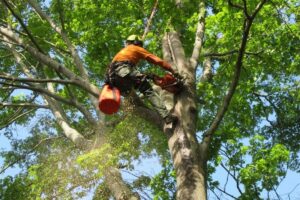
Confined space tree work relies on manual rigging and sectional dismantling to remove trees in areas where standard equipment cannot reach. Arborists climb trees and lower branches piece by piece using rope systems, allowing precise control when working between buildings or over driveways. This method prevents damage to adjacent structures while maintaining complete control over each section as it descends.
Equipment Adaptations
Equipment adaptations include compact chainsaws, hand saws, and portable rigging gear designed for tight spaces where traditional machinery would cause property damage. Arborists use:
- Lightweight rigging blocks and pulleys for controlled lowering
- Compact climbing gear that allows movement in restricted canopies
- Hand tools when power equipment poses risks to nearby windows, fences, or vehicles
Specialized Pruning Techniques
Specialized pruning techniques involve strategic branch removal that accounts for limited working angles and proximity to structures. Arborists assess branch weight distribution and use directional cuts to guide limbs away from buildings during removal. This precision work requires extensive training and experience to execute safely.
The benefits extend beyond immediate safety concerns. These techniques preserve surrounding vegetation, protect property values, and allow urban residents to maintain mature trees that would otherwise require complete removal. What can an arborist Chatswood do for urban blocks with limited access? They can execute complex tree work that balances urban development needs with environmental preservation.
How Does Tree Pruning Support Tree Health and Urban Safety?
Tree pruning involves the removal of specific branches in order to maintain the tree’s structure and prevent hazards to buildings, powerlines, and pedestrian areas. Arborists focus on removing dead, diseased, or crossing limbs that disrupt the tree’s natural shape. This allows the canopy to develop a balanced distribution of weight, which in turn reduces strain on the trunk and main branches.
Storm Damage Reduction
Strategic cuts are made during pruning to decrease wind resistance and prevent branch failure during severe weather events. Arborists thin out dense canopies to allow wind to pass through, rather than creating surfaces that catch gusts like sails. Weak branch unions with included bark—where two branches grow too closely together—are also targeted for removal as they are prone to splitting during storms and causing damage to property or injury.
Urban Tree Health Improvement
Pruning also benefits urban trees by opening up the canopy to sunlight and air circulation. This helps to reduce fungal infections and pest infestations that are common in crowded urban environments. Proper cuts are made just outside the branch collar in order to allow trees to naturally seal wounds and prevent decay from entering the trunk. Arborists carefully time their pruning activities according to each species’ growth patterns, avoiding periods when cuts may stress the tree or attract disease.
Regular pruning can extend the lifespan of trees in confined urban spaces by:
- Directing growth away from structures and utilities
- Removing competing leaders that weaken the main trunk
- Reducing overall weight on aging branches
- Maintaining clearance for vehicles and pedestrians
How Is Underground Root Management Handled in Urban Settings?
Arborists conduct thorough root assessment to identify systems threatening building foundations, driveways, and underground utilities before visible damage occurs. They use specialized equipment to map root spread and depth, determining which roots pose structural risks and which remain essential for tree stability. This diagnostic approach prevents guesswork that could either leave problems unresolved or unnecessarily harm healthy trees.
Treatment options balance foundation protection with tree preservation through several targeted methods:
- Root pruning removes problematic roots at strategic points while maintaining the tree’s structural integrity
- Root barriers install physical shields that redirect growth away from vulnerable infrastructure. These barriers can be particularly effective in preventing subsidence caused by invasive root systems, as detailed in this article on how to prevent subsidence with root barriers
- Soil modification adjusts moisture levels and compaction to discourage roots from seeking water near foundations
- Selective thinning reduces the tree’s water demands, limiting aggressive root expansion
Underground root management becomes critical in established urban blocks where mature trees and aging infrastructure coexist. Roots seeking moisture can crack concrete, lift pavement, and penetrate sewer lines, leading to repair bills reaching thousands of dollars. Proactive management identifies these threats early, when intervention costs remain minimal compared to foundation repairs or utility line replacement.
Arborists coordinate with structural engineers when root systems have already compromised buildings, developing solutions that stabilize both the structure and the tree. This collaborative approach preserves valuable urban canopy while protecting property investments in space-constrained environments.
When Is Tree Lopping Appropriate for Space-Constrained Urban Blocks?
Tree lopping becomes appropriate when urban trees outgrow their allocated space and threaten structures, power lines, or neighboring properties. An arborist Chatswood uses professional size reduction techniques that balance immediate space constraints with long-term tree health, targeting specific sections while maintaining the tree’s structural integrity.
Professional vs. Indiscriminate Lopping
Traditional tree lopping involves cutting branches at arbitrary points, leaving large wounds that invite disease and decay. Professional arborists approach size reduction differently:
- Making strategic cuts at natural branch unions to minimize stress
- Removing entire limbs rather than leaving stubs that won’t heal properly
- Preserving the tree’s natural defense mechanisms against pathogens
- Planning cuts to maintain balanced weight distribution
Pruning vs. Lopping: Impact on Tree Health
Pruning removes selective branches to shape growth and maintain health, while lopping drastically reduces tree size through severe cutting. Pruning cuts heal faster and maintain the tree’s natural form. Lopping creates large wounds, stimulates weak regrowth, and can shorten the tree’s lifespan significantly.
Municipal Compliance
Many urban councils regulate tree height near power lines, property boundaries, and sight triangles at intersections. Arborists navigate these regulations while advocating for the least invasive approach, often proposing pruning alternatives that satisfy legal requirements without compromising tree vitality.
How Do Arborists Respond to Emergency Tree Situations in Urban Areas?
Emergency response in urban areas starts when trees unexpectedly fall, creating immediate dangers in residential and commercial areas. Arborists handle these critical situations by being available 24/7 and using specialized equipment designed for quick cleanup in tight urban spaces.
Common tree emergencies that need immediate action:
- Fallen trees blocking driveways, streets, or pedestrian pathways
- Storm-damaged branches hanging dangerously over buildings or vehicles
- Uprooted trees posing a threat to power lines or structural stability
- Trees leaning precariously after severe weather events
When professional arborists arrive at the scene, they strictly follow safety hazards assessment protocols. They secure the area, assess structural risks, and determine the safest sequence for removal. This systematic approach prevents further damage during the extraction process, which is especially important when trees have fallen across multiple properties or are entangled with utilities.
The importance of coordination with local authorities
Coordination with local authorities is a crucial part of emergency response. Arborists communicate with council representatives about road closures, collaborate with utility companies when power lines are involved, and document incidents for insurance purposes. This cooperative approach ensures compliance with local regulations while speeding up the restoration of normal access.
The impact of quick response on public safety and property protection
The speed at which arborists respond directly affects public safety and property protection. Experienced arborists arrive prepared with chainsaws, rigging equipment, and safety gear suitable for working in compromised conditions. This enables them to clear access routes within hours instead of days.
What Role Does Hedge Trimming Play in Urban Privacy and Safety?
Hedge trimming serves two purposes in urban areas: it creates visual barriers between properties and meets safety requirements set by the local government. Arborists are responsible for maintaining formal hedges and privacy screening that define property boundaries without taking up too much space. This makes them perfect for narrow lots and compact urban developments.
Ensuring Safety on Footpaths
To comply with pedestrian clearance regulations, hedges along footpaths must be kept at specific heights and distances from the edge. This is done to preserve sight lines at intersections and driveways, ensuring that drivers and pedestrians can see each other clearly. Local councils enforce these standards to prevent accidents caused by overgrown vegetation blocking views.
Professional Knowledge in Hedge Trimming
Professional arborists understand these safety requirements and are trained to trim hedges accordingly. They know how to maintain the desired height and distance while still keeping the hedges effective as privacy screens.

Specialized Techniques for Healthy Hedges
In confined spaces, specialized techniques are used to keep hedges healthy and visually appealing:
- Selective pruning: This technique encourages dense growth at the base of the hedge while controlling its height.
- Thinning cuts: These cuts improve air circulation within the hedge and reduce the risk of diseases in compact plantings.
- Shaping methods: These methods maintain formal lines in the hedge without creating bare patches or uneven growth.
Regular Maintenance for Neat Hedges
Regular maintenance schedules are essential to prevent hedges from becoming overgrown. Overgrown hedges can encroach on pathways or neighboring properties, causing inconvenience or disputes. Such scenarios often lead to calls for intervention based on residential code compliance, which outlines the standards for maintaining property boundaries.
Arborists use hand tools and compact equipment that are suitable for tight access points. This ensures that their work is precise and does not cause any damage to adjacent structures or utilities.
By maintaining neat hedges through regular trimming, we can enhance the aesthetic value of urban landscapes while also addressing practical safety concerns that come with high-density residential areas. Check out more about how to prevent tree failures in dense, bushland-adjacent areas.
Why Should You Hire Professional Arborists for Complex Urban Tree Care Needs?
Professional arborists have the specialized knowledge and skills to handle the unique challenges of urban environments with limited access. They are trained to navigate narrow pathways, work around underground utilities, and ensure the safety of nearby structures while keeping trees healthy.
Comprehensive services offered by arborist professionals in Chatswood include:
- Crane-assisted removals when traditional equipment cannot reach tight spaces
- Locating underground services before any excavation work
- Using techniques for confined spaces that prevent damage to properties
- Managing roots in a way that protects building foundations
- Having protocols in place for emergencies such as fallen trees blocking access
The benefits of hiring qualified arborists go beyond just immediate tree work. They are familiar with the regulations governing urban block tree management and can ensure that local council requirements are met while maintaining the character of the neighborhood. Additionally, they can assess the long-term health of trees, recommend preventive maintenance measures, and implement solutions that prioritize safety without harming the environment.
